Publisher
d’Escrivan
Eléonore
Valenciennes, France
Hosting
OVH
2 rue Kellermann - 59100 Roubaix - France
Contacts


Master thesis
Discover
41% of broken products are replaced without any repair attempt, yet 96% of repair attempts are rated highly satisfactory. Extending their lifespan by just 3 years could save 4 million tonnes of CO2
in France, the same as taking every car off the road for almost three weeks.
Making repair the norm is an important behavioral and ecological concern.
ADEME
“How might we instill repair
as the cultural norm
in France?”
Work in progress - February 2026

Solo project

User research
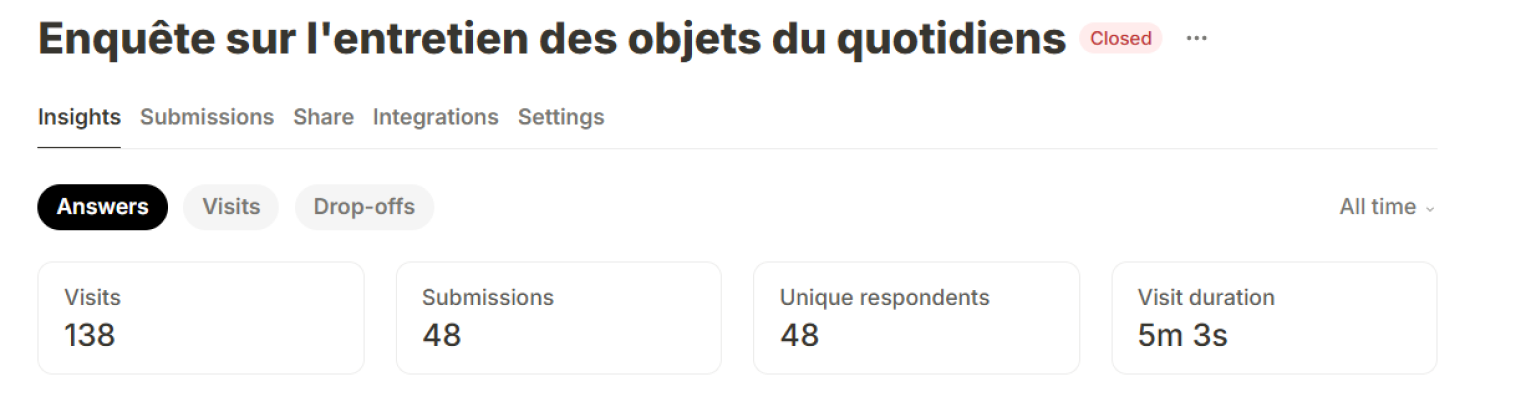
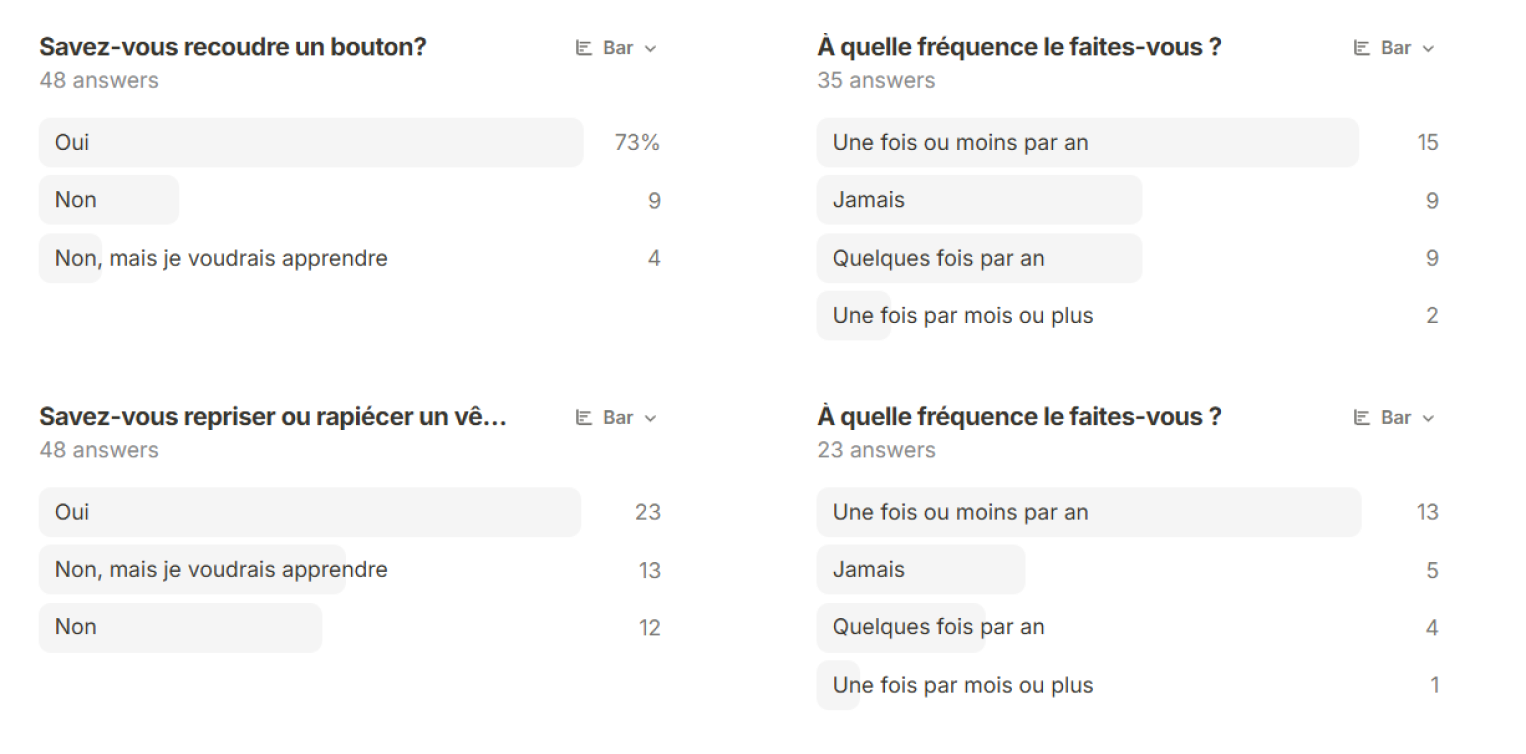
I combined desk research with a survey of 48 respondents to map current repair habits, field research at a Repair Café to observe existing non-professional solutions,
and a month-long diary study with 5 participants to track real repair attempts
over time.
Item visibility:
Broken items get put aside and forgotten,
so making them impossible to ignore
is the first step.
Desirability :
Repair still carries a lower status than buying new, so the goal is to make it something people
want to be seen doing, not settle for.
Ecosystem awareness :
People don't know the different repair options available to them, and in many french regions
those options are genuinely limited.
Time :
People know an item needs fixing
but never carve out the time.
Access:
Spare parts, tools and tutorials do exist,
but they're hard to find.
Cost :
Repair is often more expensive than replacing,
it's a real disadvantage repair has to overcome.
Effort :
Every extra step in the repair process pushes people back toward buying new, so friction
has to come down at every stage.
Uncertainty :
Buying new comes with a known price and known quality. Repair offers neither: unclear cost, unclear timeline, no guarantee it holds, which makes
it hard to judge whether an object is even worth the effort.
Next generation:
Repair propensity forms slowly
throughout childhood. Combining skills, values
and cultural identity in how children are taught could produce the next generation of repairers.
Insight
Survey
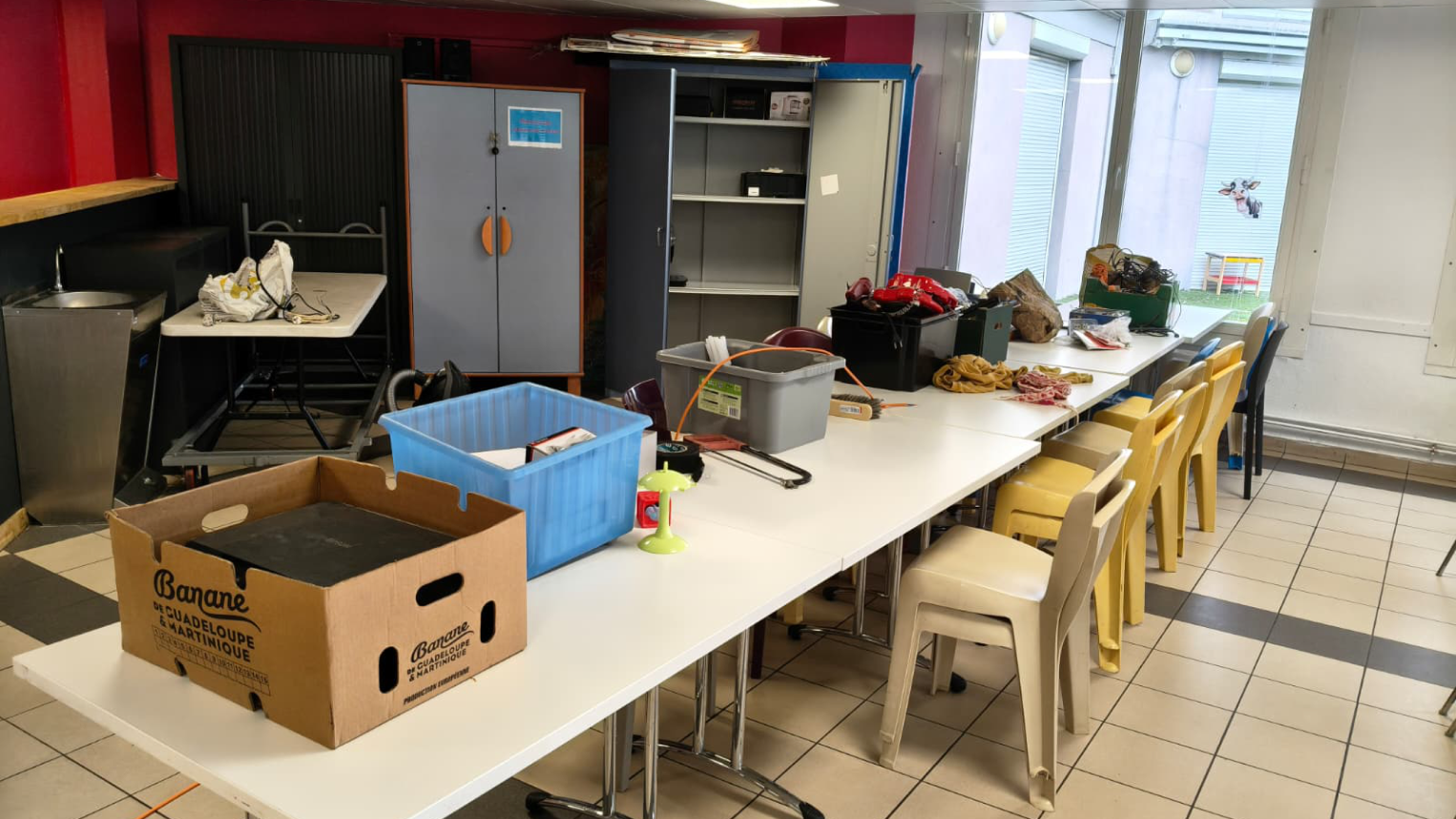
Repair café des Bois-Blancs - Lille, France
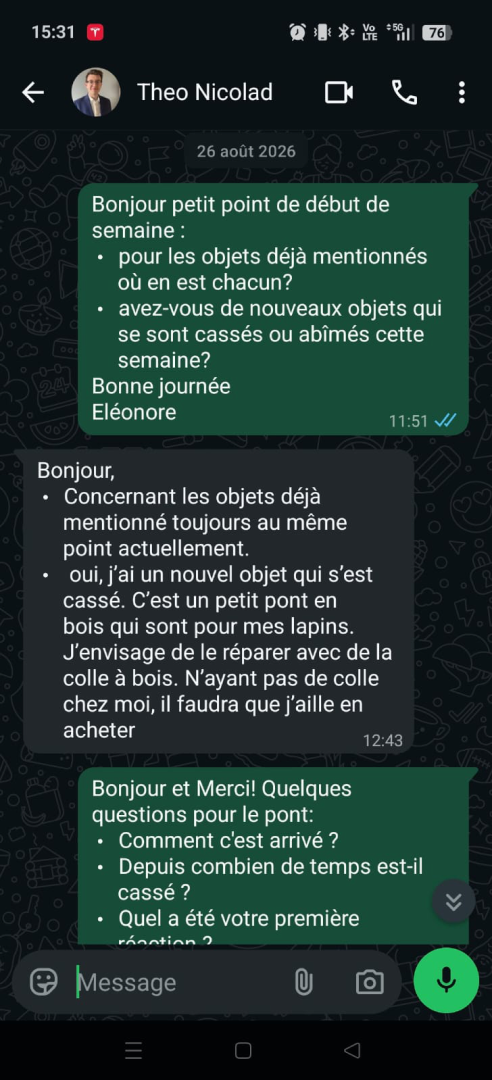
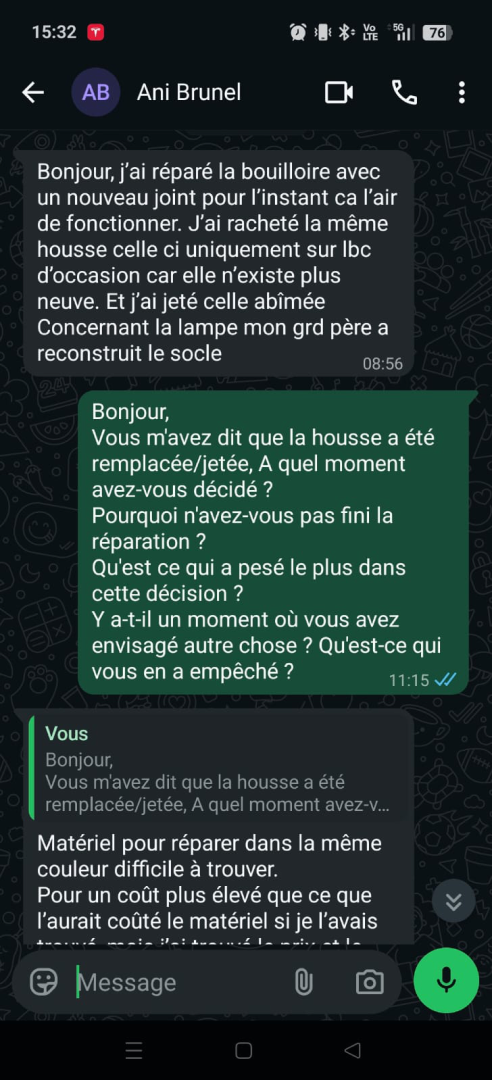
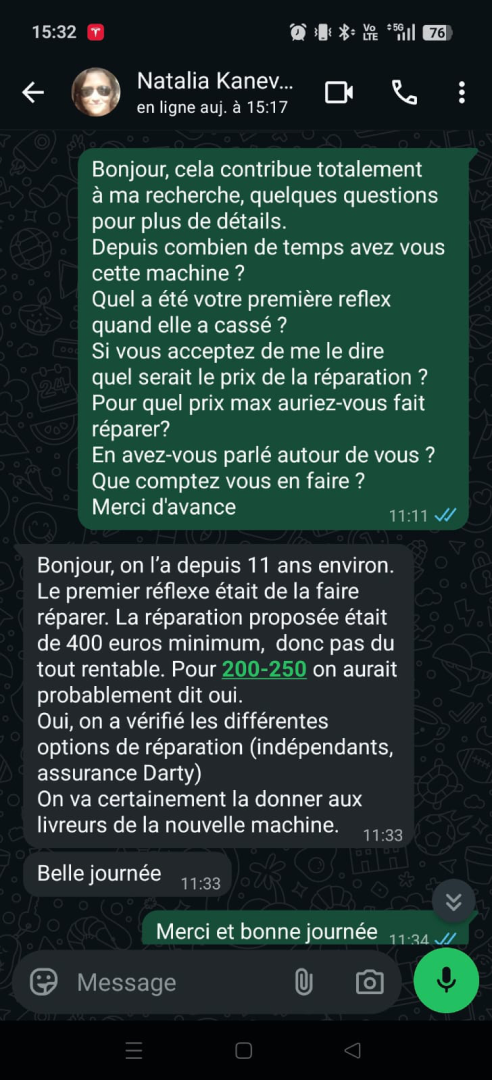
Diary study via whatsapp
User journey
I conducted I diary study with 5 participants I followed over the course of a month.
From this study, I mapped the user journey.


1. Discovering
the wear, tear
or breakage
2. The item
is set aside
3. Looking
for advice
and solutions
4. Choosing between
repairing, replacing
or throwing away
5. Looking
for a repairer
or supplies
6. Final confirmation:
is the effort or cost
identified acceptable?
7. doing the act of repairing,
having it repaired
or replacing it
8. Item successfully
repaired and reused
9. Item replaced
or discarded

User repair journey
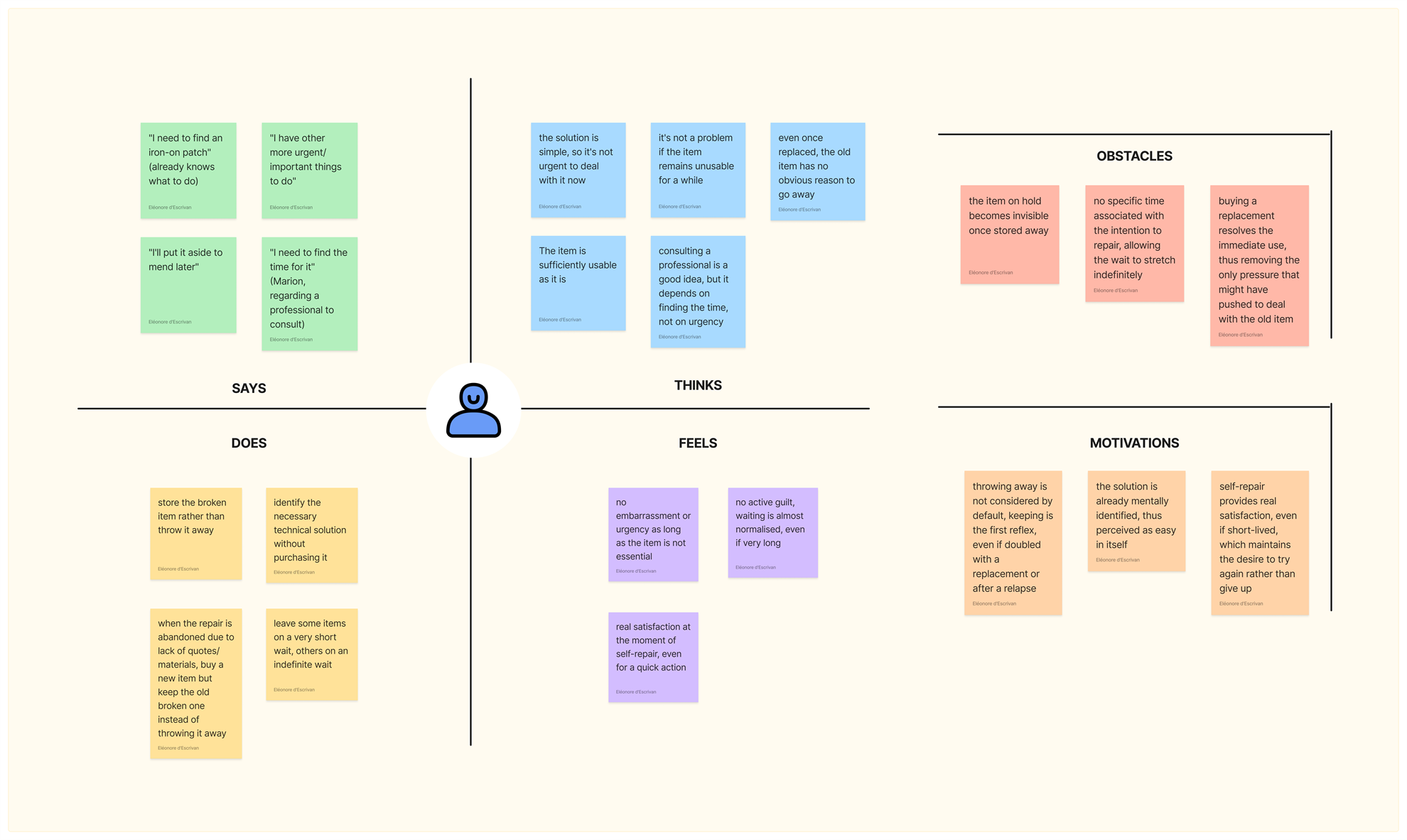
drop out (item kept indefinitely without being worked on, or item replaced or thrown away)


Empathy map: the Keeper-in-Waiting
Co-design
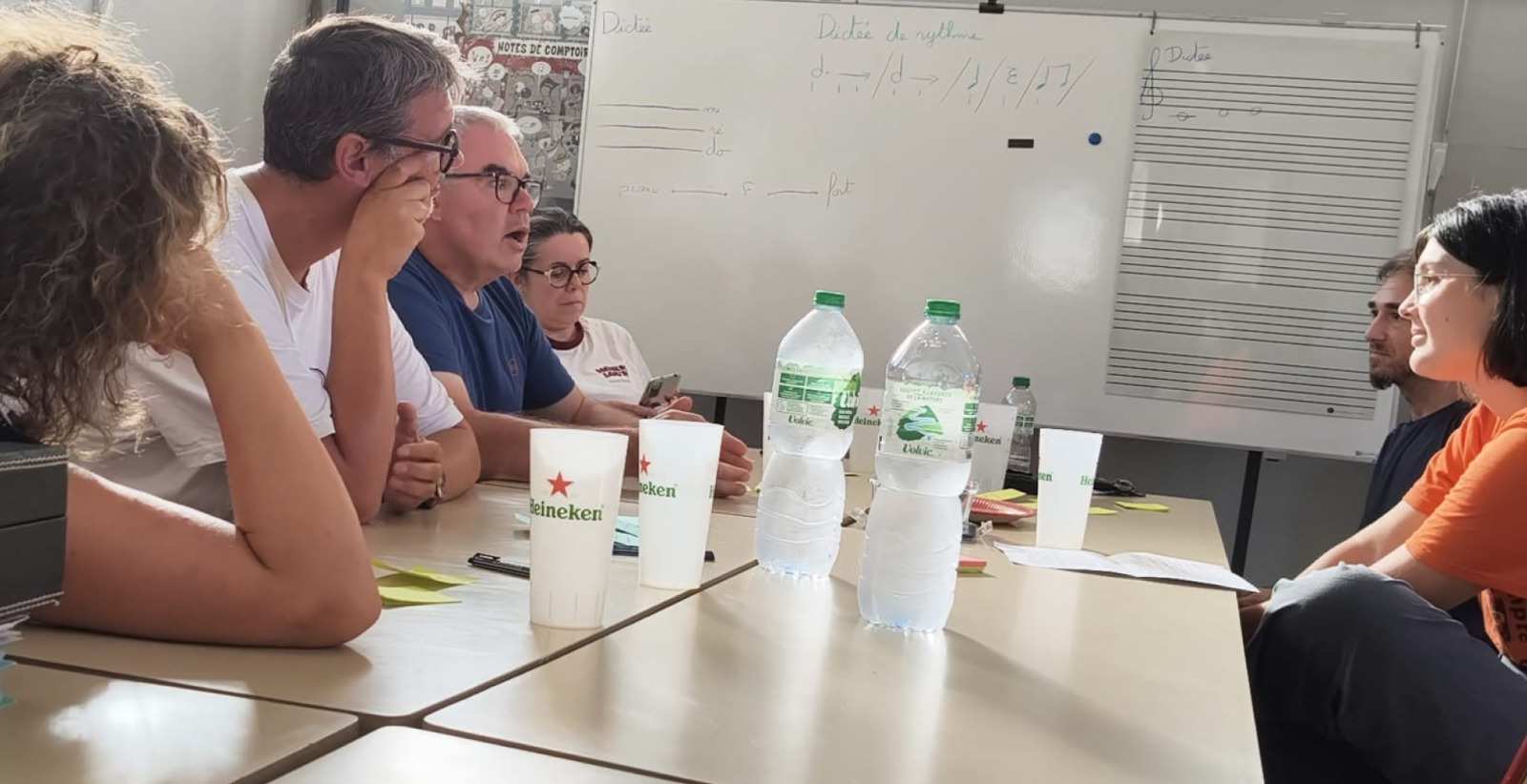
To develop the building repair propensity opportunity, I conducted a co-design session with education professionals.
Diagnostic
Embed diagnostic skills into existing
sorting/tidying exercises
Why?
Explain overconsumption directly (why objects should last)
Handiwork
Treat fine motor skills and handiwork as a prerequisite
Care
Build preventive care and maintenance not just diagnosing and fixing after the fact.
Every action should be linked to existing curricula
Younger generations can drive systemic change, as seen with waste sorting, which became the norm once it was taught in schools from 2002 and is now reinforced
by young adults correcting older generations. But a generation raised to want repair still needs somewhere to actually repair. Without a solid, resilient ecosystem
behind it, that willingness has nothing to land on, so my focus is the ecosystem stream first.
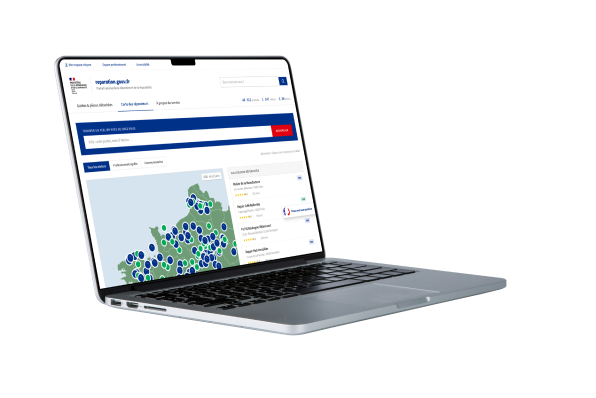



World 1:
Harnessed energy
Harnessed energy
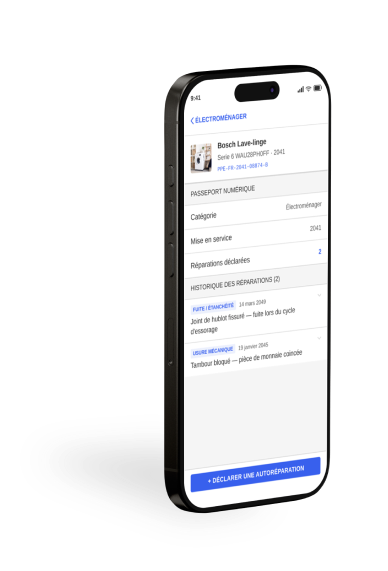



World 2:
Repairability
as a credit criterion,
under carbon card
Repairability
as a credit criterion,
under carbon card

World 3:
The five-speed society
The five-speed society
Design fiction
Openning a debate about which future of consumption we actually want by 2050.
Discover world 1

Discover world 2

Discover world 3

Personal reflexion
What really made me question my approach is that this problem
is systemic, but it was also the reason I chose it and I like
that dual nature. I chose this topic because it's ecological,
it affects purchasing power, and changing consumption habits shapes the world we'll actually get to live in. But working
on it means working against capitalism itself,
and that's not something I can change at my scale. So my service has to make repair work within a capitalist society rather
than against it.
My early concept assumed people would share their time, skills and information just because it helps scaling repair, and I realize now that's not a strong enough reason, it was too idealistic.
So I've gone back to something closer to what worked on CHV: letting the people who'll use the service help build it.
I've launched a Kano study comparing the features I imagined against those of existing repair systems, to see which functions people actually want, and I have a debate around my design fiction coming up that should surface more. What I need to keep holding onto going forward: goodwill alone won't make
this service work, people need a real reason to use it.
What’s next ?
My next step is to design, prototype and test a concept that helps people who keep their broken items arrange for repairs and see the process through to the end.
Alongside that, I want to bring the design fiction
out of the research phase and into the open, presenting it publicly to open a debate on which future of consumption we actually want.

X-trim