Publisher
d’Escrivan
Eléonore
Valenciennes, France
Hosting
OVH
2 rue Kellermann -
59100 Roubaix -
France
Contacts


World 3:The five-speed society
Presentation
In 2050, the repairability index is honest, public, and no one is fooled by it. Nothing stops anyone, however, from selling objects
that will never be repaired, and the majority cannot afford anything else. Five market zones coexist, from rock-bottom prices to artisanal ultra-luxury, and repair survives mostly through resourcefulness.
Story
In 2027, direct-import platforms generalise just-in-time production, optimised only for cost. Objects break quickly, but no one ever announced it: it is an effect of falling prices, never a stated goal.
At first it is seen as a logistical simplification serving purchasing power. Over time, rapid breakage becomes
statistically commonplace.
In 2030, investigations reveal that several “high-end” brands manufacture in the same factories as the mid-range.
The repairability index, for its part, remains reliable and continues
to rate each product honestly, a bit like a Nutri-Score. The brands concerned respond by talking about image rather than about where things are made. The idea takes hold that price is no guarantee
of quality, without changing the way people buy.
In 2034, independent mid-range repairers equip themselves with 3D printers to make the substitute parts that manufacturers no longer sell. It is presented as a pragmatic adaptation of the trade. Bruno, one of them, sees most of the repair demand pass through his shop, but his margin is melting: every printed part is time spent,
with no warranty. He finds it normal to repair without the right parts, it has always been the trade. He considers it unacceptable that manufacturers deliberately make their products incompatible with any non-official part.
In 2039, recycling and sorting supply chains reach a point
of structural saturation. A majority of low-end and mid-range objects stop being sent to recycling: the default destination
of an end-of-life object becomes plain waste again. It is presented as a simple logistical adjustment to volume.
Over these years, five market zones have taken hold, with blurred boundaries. A low end, whose quality is so poor that the object breaks after a few uses without ever having been presented
as disposable. A mid-range, which is what the majority buys, repairable once with resourcefulness but without official parts. A high end, made in the same factories and sold at a higher price
for identical quality. A true luxury, genuinely repairable, less and less accessible as purchasing power falls. And an artisanal ultra-luxury, out of reach.
Nadia, a mother in a working-class neighbourhood, mostly buys
low-end goods. She reads the label: she knows what she is buying, and she knows it will not last. She simply cannot afford anything else. If someone told her she does not know, she would not put up with it. What she underestimates is what happens to her purchases
once they are thrown away.
One Saturday morning in 2050, she pushes open the door of Bruno's workshop with her daughter's hair dryer. This time she paid a little more, with full knowledge of the facts: the index said 4 out of 10, and she had understood what that meant. Bruno puts two quotes on the counter. The original part: 38 euros and a three-week wait. The part printed in the back room: 9 euros, no warranty. She takes the second, like almost everyone in the queue, and sits down to wait.
Through the window, you can see the skip of the neighbouring recycling centre, overflowing with small appliances. No one looks
at it anymore. On her phone, an independent comparison site ranks hair dryers by price range and repairability. The cheapest
new model, at 14.90 euros, is rated 2 out of 10, and costs less than the original part. She puts her phone away and waits
for her hair dryer.
People are said to “buy with full knowledge of the facts.” It is neither a reproach nor a compliment.
with their impact and repairability, so people can choose before they buy.
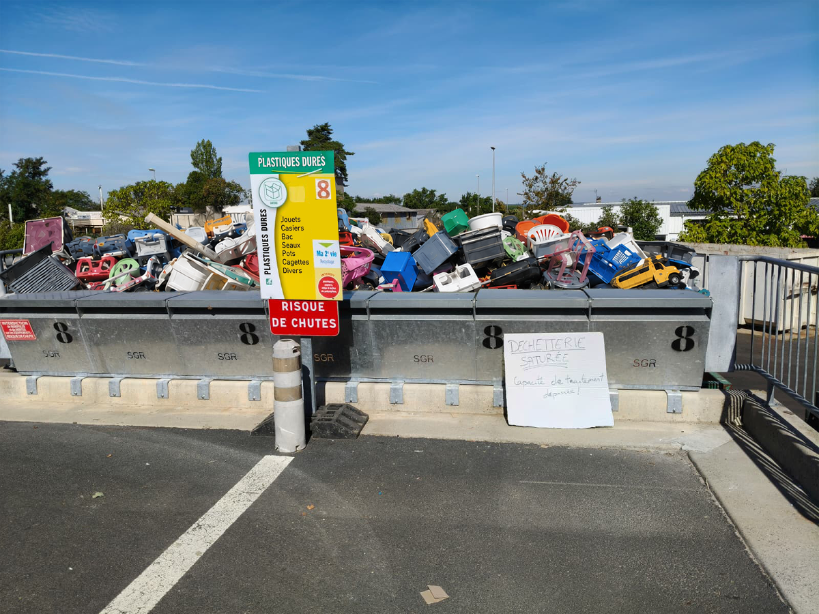
and no one looks at it anymore.